
Tip Calculator
Calculate tip amount and split the bill across any number of people
Real-Life Guide to Using the Tip Calculator
Split bill and calculate tip. Use the examples and checks below to turn the number into a practical decision.
When this calculator is useful
Useful when splitting a restaurant bill among friends in a country where service charge is often already baked into the bill, or when you want to leave a fair tip in cities where card tipping isn't standard.
For most people, the best way to use the Tip Calculator is to try the real case first, then change one input at a time. That makes the trade-off visible. For example, with a loan calculator you can change tenure while keeping the same rate; with an investment calculator you can change return assumption while keeping the same monthly contribution; with a health, education or measurement calculator you can check how much one input changes the final category.
The result should answer a practical question: Can I afford this? How much should I save? Is this score enough? Is this measurement within range? What is the safer or cheaper option? If the output does not answer the decision clearly, adjust the inputs until the scenario matches your real situation.
Practical Advice
Use the Tip Calculator as a planning tool, not just a number generator. Write down the inputs you used, because the final answer is meaningful only when you remember the assumptions behind it.
If the decision affects money, health, tax, safety, academics or legal compliance, keep a second check ready. That second check may be a bank quote, payslip, official rule, prescription, site measurement, mark sheet or invoice.
Common Mistakes
- Tipping on the bill total after GST (5% or 18%) has already been added, which inflates the tip by tipping on tax rather than the food cost.
- Not checking whether "Service Charge" is already listed as a separate line item — tipping again on top of it means paying twice for service.
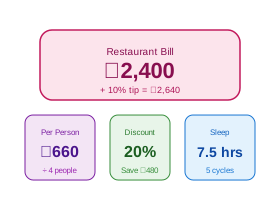
- Splitting ₹2,400 four ways as ₹600 each without adjusting for one person who only had a ₹150 coffee while others shared a ₹2,000 meal.
- Using a flat 10% for every occasion when 5% is typical for casual dhabas and 15-20% is more standard at premium restaurants.
- Rounding the tip down to the nearest ₹10 out of habit, which can undertip by ₹8-9 on a mid-size bill without realizing it.
How to Interpret Results
The tip amount shown is calculated on the pre-tax subtotal you enter, so if your bill already includes GST, back that out first; the per-person split simply divides the bill+tip evenly unless you're tracking individual items separately.
A good interpretation looks at both the main result and the supporting values. If a page shows totals, ratios, categories, schedules or warnings, read those together instead of focusing only on the biggest number.
Tip Calculator FAQs
Useful answers for interpreting the output, avoiding mistakes and using the result responsibly.
Tip Calculation Formula
Tip amount = Bill × (Tip % ÷ 100). Total bill = Bill + Tip. Per-person share = Total ÷ Number of people. The calculator rounds to 2 decimal places for each person.
Tipping culture varies globally. In the USA, 18–20% is standard. In India, tipping is appreciated but not mandatory — 5–10% is a common courtesy at sit-down restaurants, while delivery and hospitality tips are smaller and discretionary.