
Quadratic Formula Calculator
Solve ax² + bx + c = 0 — real and complex roots with discriminant
Real-Life Guide to Using the Quadratic Formula
Roots of ax² + bx + c = 0. Use the examples and checks below to turn the number into a practical decision.
When this calculator is useful
Use this to find the roots of an equation in the form ax² + bx + c = 0 when factoring is not obvious, or to check the discriminant and determine whether the roots are real or complex.
For most people, the best way to use the Quadratic Formula is to try the real case first, then change one input at a time. That makes the trade-off visible. For example, with a loan calculator you can change tenure while keeping the same rate; with an investment calculator you can change return assumption while keeping the same monthly contribution; with a health, education or measurement calculator you can check how much one input changes the final category.
The result should answer a practical question: Can I afford this? How much should I save? Is this score enough? Is this measurement within range? What is the safer or cheaper option? If the output does not answer the decision clearly, adjust the inputs until the scenario matches your real situation.
Practical Advice
Use the Quadratic Formula as a planning tool, not just a number generator. Write down the inputs you used, because the final answer is meaningful only when you remember the assumptions behind it.
If the decision affects money, health, tax, safety, academics or legal compliance, keep a second check ready. That second check may be a bank quote, payslip, official rule, prescription, site measurement, mark sheet or invoice.
Common Mistakes
- Forgetting the ± in the formula and reporting only one root instead of both x = (-b + √D) ÷ 2a and x = (-b - √D) ÷ 2a.
- Making a sign error in the discriminant b² - 4ac when a or c is negative — for x² - 4x - 5 = 0, the discriminant is 16 - 4(1)(-5) = 16 + 20 = 36, not 16 - 20.
- Dividing only part of the numerator by 2a, computing (-b + √D) ÷ 2a as -b + (√D ÷ 2a) instead of dividing the entire sum by 2a.
- Assuming a negative discriminant means "no solution" rather than "no real solution" — the equation still has two complex conjugate roots.
- Not reading off a, b, and c correctly from a non-simplified equation, such as failing to recognize a = 2, b = 8, c = 6 directly from 2x² + 8x + 6 = 0.
How to Interpret Results
Check the discriminant value alongside the roots — a positive discriminant means two distinct real roots, zero means one repeated real root, and a negative discriminant means two complex conjugate roots with no real x-intercepts on a graph.
A good interpretation looks at both the main result and the supporting values. If a page shows totals, ratios, categories, schedules or warnings, read those together instead of focusing only on the biggest number.
Quadratic Formula FAQs
Useful answers for interpreting the output, avoiding mistakes and using the result responsibly.
The Quadratic Formula
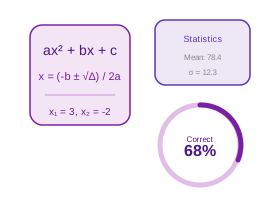
A quadratic equation has the form ax² + bx + c = 0 where a ≠ 0. The quadratic formula x = (−b ± √D) / 2a always works, regardless of whether the equation can be factored. The discriminant D = b² − 4ac tells you the nature of roots before solving.
The vertex form of the parabola is y = a(x − h)² + k where h = −b/2a and k = f(h). The axis of symmetry is the vertical line x = h that the parabola is symmetric about.