
Height Converter
Convert height between centimetres, metres, feet and inches instantly
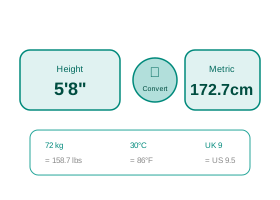
| cm | ft & in | m |
|---|---|---|
| 150 | 4′11.1″ | 1.50 |
| 155 | 5′1.0″ | 1.55 |
| 160 | 5′3.0″ | 1.60 |
| 165 | 5′5.0″ | 1.65 |
| 170 | 5′6.9″ | 1.70 |
| 175 | 5′8.9″ | 1.75 |
| 180 | 5′10.9″ | 1.80 |
| 185 | 6′0.8″ | 1.85 |
Real-Life Guide to Using the Height Converter
cm to feet/inches and back. Use the examples and checks below to turn the number into a practical decision.
When this calculator is useful
Useful when filling out a visa, passport, gym membership, or matrimonial profile form that asks for height in feet/inches but you only know your height in centimetres from an Indian hospital or school record, or the reverse.
For most people, the best way to use the Height Converter is to try the real case first, then change one input at a time. That makes the trade-off visible. For example, with a loan calculator you can change tenure while keeping the same rate; with an investment calculator you can change return assumption while keeping the same monthly contribution; with a health, education or measurement calculator you can check how much one input changes the final category.
The result should answer a practical question: Can I afford this? How much should I save? Is this score enough? Is this measurement within range? What is the safer or cheaper option? If the output does not answer the decision clearly, adjust the inputs until the scenario matches your real situation.
Practical Advice
Use the Height Converter as a planning tool, not just a number generator. Write down the inputs you used, because the final answer is meaningful only when you remember the assumptions behind it.
If the decision affects money, health, tax, safety, academics or legal compliance, keep a second check ready. That second check may be a bank quote, payslip, official rule, prescription, site measurement, mark sheet or invoice.
Common Mistakes
- Reading "5.6 feet" from a decimal converter as 5 feet 6 inches, when 5.6 feet actually means 5 feet and 0.6×12 = 7.2 inches — a nearly 1-inch error that matters on official forms.
- Rounding 162 cm to "about 5 foot 4" and writing that on a document instead of the precise 5 feet 3.8 inches, which can cause mismatches with a measured height on ID verification.
- Confusing height measured with shoes on versus barefoot — many home measurements include shoe sole height (1-3 cm), leading to a converted figure that's taller than the true barefoot height.
- Applying the conversion inconsistently — converting a child's height at a doctor's visit in cm but comparing it to a growth chart calibrated in inches without converting both to the same unit first.
- Forgetting that "5'6\"" notation uses feet and inches, not feet and a decimal — mistyping 5.6 into a field expecting 5 feet 6 inches produces a different, taller height than intended.
How to Interpret Results
Read the output as feet and whole inches (e.g. "5 ft 7 in"), and if a form insists on a single decimal number in feet, convert the inches portion by dividing by 12 rather than just tacking the inch number after the decimal point.
A good interpretation looks at both the main result and the supporting values. If a page shows totals, ratios, categories, schedules or warnings, read those together instead of focusing only on the biggest number.
Height Converter FAQs
Useful answers for interpreting the output, avoiding mistakes and using the result responsibly.
Height Unit Systems
Height is measured in different units depending on the country. India, like most of the world, officially uses the metric system — centimetres (cm) or metres (m). However, feet and inches remain in common use for everyday height description in India, often alongside metric.
The US and UK primarily use feet and inches. Medical records in India use cm. Clothing and fitness apps may use either. This converter handles all combinations accurately.