
mail

Post Office Schemes Calculator

Calculate returns for MIS, NSC and KVP — India Post government-backed savings schemes
edit_calendar Last updated: Jul 22, 2026 | verified Reviewed by Calkulator Team | timer 2 min read
Investment illustration
Investment

Compare MIS, NSC, and KVP returns side by side

Post office schemes offer government-backed guaranteed returns. MIS gives monthly income on your deposit, NSC compounds over 5 years, and KVP doubles your money in a fixed period. Each suits a different need.

tips_and_updates NSC interest qualifies for Section 80C deduction — making it one of the most tax-efficient fixed-income options.
tuneSelect Scheme & Amount
MIS — Monthly Income Scheme
7.4% p.a. | 5-year tenure | Monthly payout | Max ₹9L single / ₹15L joint
Deposit Amount
≈ 5 Lakh
Account Type
Monthly Income (MIS)
Total Interest (5 Yrs)
Government guaranteed
Scheme Comparison — Same Investment
Scheme Rate Tenure Payout/Maturity Gain

functions Scheme Highlights

MIS: Monthly payout, interest not reinvested, 5yr

NSC: 80C eligible, compounded annually, 5yr

KVP: Doubles in ~9.6 years, transferable

All backed by Govt. of India — zero default risk

insights
Live Result Illustration
Visual summary — updates instantly as you enter values above
LIVE
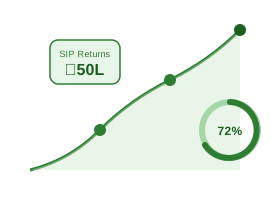
Investment Growth Summary Enter values above to update Invested ₹18 L Amount Total Corpus ₹50.5 L Maturity Total Gains ₹32.5 L Returns on Investment +180% Start early — 5 extra years can nearly double your corpus through the power of compounding.
tips_and_updates

Real-Life Guide to Using the Post Office Schemes

MIS, NSC, KVP returns. Use the examples and checks below to turn the number into a practical decision.

When this calculator is useful

For savers considering government-backed post office schemes — the Monthly Income Scheme (MIS) for a regular payout, NSC for a 5-year fixed-return certificate with 80C benefit, or KVP for a simple lump-sum-doubles product — and wanting to see approximate returns before visiting the post office.

For most people, the best way to use the Post Office Schemes is to try the real case first, then change one input at a time. That makes the trade-off visible. For example, with a loan calculator you can change tenure while keeping the same rate; with an investment calculator you can change return assumption while keeping the same monthly contribution; with a health, education or measurement calculator you can check how much one input changes the final category.

The result should answer a practical question: Can I afford this? How much should I save? Is this score enough? Is this measurement within range? What is the safer or cheaper option? If the output does not answer the decision clearly, adjust the inputs until the scenario matches your real situation.

lightbulb Real-Life Example
Monthly Income Scheme payout: A retired couple invests ₹9,00,000 (the joint-account limit) in the Post Office Monthly Income Scheme at an assumed 7.4% per annum.
1Monthly payout = (9,00,000 × 7.4%) / 12 = ₹5,550 every month for the 5-year tenure, with the full ₹9,00,000 principal returned at the end of the term since MIS interest is not compounded and does not reduce the principal.
2Now change one input, such as rate, time, quantity, unit or score, and compare the new result with the first one.
MIS is built for steady monthly cash flow with the principal fully protected, not for growing the invested amount itself, so it suits regular income needs more than wealth accumulation.

Practical Advice

Use the Post Office Schemes as a planning tool, not just a number generator. Write down the inputs you used, because the final answer is meaningful only when you remember the assumptions behind it.

If the decision affects money, health, tax, safety, academics or legal compliance, keep a second check ready. That second check may be a bank quote, payslip, official rule, prescription, site measurement, mark sheet or invoice.

Common Mistakes

  • Assuming all three schemes (MIS, NSC, KVP) work the same way, when MIS pays monthly interest without compounding, NSC compounds annually and pays out only at maturity, and KVP simply doubles the invested amount over a fixed period with no interim payout.
  • Forgetting that MIS interest is paid out monthly and does not itself earn further interest unless manually reinvested elsewhere, so treating MIS as a "compounding" investment overstates its growth.
  • Claiming an 80C deduction on the NSC investment amount but forgetting that the interest reinvested each year (except the final year) is also eligible for 80C, while the final year's interest is fully taxable with no further deduction.
  • Assuming KVP offers a tax deduction like NSC or PPF, when KVP investments get no 80C benefit and the interest earned is fully taxable at slab rate.
  • Exceeding the maximum investment limit for MIS (commonly ₹9,00,000 for a joint account, ₹4,50,000 for a single account, limits subject to change) without checking current post office rules before planning around a larger amount.

How to Interpret Results

For MIS, read the output as a fixed monthly payout with your principal fully intact and returned at maturity; for NSC and KVP, read it as a lump sum that is inaccessible until maturity but grows at a fixed government-notified rate with no market risk.

A good interpretation looks at both the main result and the supporting values. If a page shows totals, ratios, categories, schedules or warnings, read those together instead of focusing only on the biggest number.

quiz

Post Office Schemes FAQs

Useful answers for interpreting the output, avoiding mistakes and using the result responsibly.

What is the basic difference between MIS, NSC, and KVP?
MIS pays a fixed, non-compounding monthly interest amount while returning the full principal at the 5-year maturity; NSC compounds interest annually and pays everything as a lump sum at maturity while also qualifying for 80C tax deduction; KVP simply doubles your invested lump sum over a fixed government-notified period with no interim payout and no tax deduction.
How is the KVP doubling period decided?
The doubling period depends on the interest rate the government notifies for KVP at the time of investment — at an illustrative rate in the 7-7.5% range, the doubling period works out to roughly 115-120 months, but always confirm the exact current period at the post office since it changes when rates change.
Is NSC interest taxable if it also gives me an 80C deduction?
Yes — NSC interest for years 1 to 4 is deemed reinvested and itself qualifies for 80C (subject to the overall ₹1.5 lakh 80C limit), but it is still added to your taxable income each year; the final year's interest is fully taxable with no further reinvestment or deduction.
Can I withdraw my MIS, NSC, or KVP investment before maturity?
Each scheme allows premature withdrawal under specific conditions and time limits set by post office rules, typically with a penalty or reduced interest rate for early exit — check the current rules at the post office before assuming early access is straightforward.
Are these post office schemes safer than a bank FD or mutual fund?
They carry a sovereign (government) guarantee, which many consider at least as safe as a bank FD, and safer than any market-linked product like a mutual fund, though post office schemes are generally less liquid and offer fewer flexible options.
How does the calculator estimate MIS monthly payout?
It divides the annual interest (principal × annual rate) by 12, since MIS pays interest monthly on the original principal without compounding it further, unlike NSC where interest is compounded annually until maturity.
Is there a maximum amount I can invest in these schemes?
Yes, each scheme has its own investment limits set by postal rules (for example, MIS has separate single and joint account limits) which are periodically revised, so always verify the current limit at your post office or its official notification before finalising an investment amount.
Which of these three should I actually choose?
It depends on your goal — MIS suits those who need a regular monthly income stream with principal safety, NSC suits those wanting a tax-saving lump-sum investment that compounds until maturity, and KVP suits those who simply want a guaranteed doubling of a lump sum with no need for interim income or tax benefit.

Post Office Savings — Safe Returns from India Post

India Post offers several government-backed savings schemes with guaranteed returns. MIS, NSC, KVP, SCSS, PPF, and SSY are among the safest instruments available — backed by the Government of India with zero default risk.

Rates are revised quarterly by the Ministry of Finance. NSC investments qualify for Section 80C deduction. MIS provides regular monthly income ideal for retirees. KVP doubles your money in ~9.6 years with no 80C benefit but is freely transferable.

lightbulb Example Calculation
Scenario: ₹4.5 Lakh in NSC at 7.7% for 5 years
1Maturity = 4,50,000 — (1.077)^5 = ₹6,52,185
2Total Interest = ₹2,02,185 over 5 years
3Accrued interest in years 1�4 also qualifies for 80C
✓ ₹4.5L grows to ₹6.52L in 5 years with 80C deduction benefit
live_help

Frequently Asked Questions

MIS, NSC and KVP explained for Indian investors

Which is better for monthly income — Post Office MIS or bank FD?
Post Office MIS at 7.4% p.a. provides sovereign-guaranteed monthly payouts. Bank FDs offering monthly payout typically yield 6.5�7.5% depending on the bank. MIS advantage: government guarantee and no TDS if total Post Office interest is below ₹40,000/year (₹50,000 for seniors). Small Finance Banks may offer higher FD rates (up to 9%), but without government backing.
Can I claim Section 80C deduction on Post Office schemes?
Yes, but only for NSC. The investment amount qualifies under 80C (up to ₹1.5L cumulative limit). NSC interest accrued each year (compounded to maturity) is treated as reinvested — this also qualifies as 80C deduction for years 1�4. In year 5, the accrued interest is taxable. MIS and KVP do not qualify for 80C deduction.
What is the key difference between KVP and NSC?
NSC: 5-year fixed tenure, 80C eligible, cannot be transferred between individuals. KVP: ~9.6-year tenure (doubles investment), no 80C benefit, certificates can be transferred and pledged as loan collateral. NSC suits tax-savers; KVP suits those prioritising maximum growth without tax constraints and wanting marketability.
keyboard_arrow_up