
currency_exchange

Currency Calculator

Convert between 35+ world currencies — approximate indicative rates
edit_calendar Last updated: Jul 22, 2026 | verified Reviewed by Calkulator Team | timer 2 min read
Conversion illustration
Conversion

Convert between 35 world currencies at approximate rates

Planning a trip to Europe? $100 USD is approximately ₹8,350. Receiving payment in GBP? £1,000 is about ₹1,05,600. These are indicative mid-market rates — actual bank rates include a 1-3% markup.

tips_and_updates For large forex transactions (education fees, property), compare rates across banks, Wise, and forex dealers.
Amount
amt
From Currency
To Currency
info Rates are approximate indicative values (mid-2025). Use a live rate service for actual transactions.
Conversion Result
Exchange Rate
Inverse Rate
insights
Live Result Illustration
Visual summary — updates instantly as you enter values above
LIVE
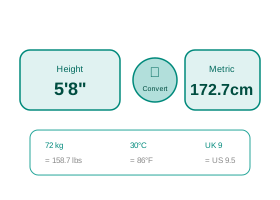
Unit Conversion Updates in real-time Input 5 ft 8 in Imperial Output 172.72 cm Metric Always round only after the full conversion is complete — early rounding causes measurement errors.
tips_and_updates

Real-Life Guide to Using the Currency Calculator

Foreign exchange rate conversion. Use the examples and checks below to turn the number into a practical decision.

When this calculator is useful

Used when you're paying for something priced in a foreign currency — booking a US hotel, buying from an international website, or checking how much your USD/EUR/AED remittance is worth in Indian rupees today.

For most people, the best way to use the Currency Calculator is to try the real case first, then change one input at a time. That makes the trade-off visible. For example, with a loan calculator you can change tenure while keeping the same rate; with an investment calculator you can change return assumption while keeping the same monthly contribution; with a health, education or measurement calculator you can check how much one input changes the final category.

The result should answer a practical question: Can I afford this? How much should I save? Is this score enough? Is this measurement within range? What is the safer or cheaper option? If the output does not answer the decision clearly, adjust the inputs until the scenario matches your real situation.

lightbulb Real-Life Example
Paying a US-based subscription in INR: Kavya's credit card is billed $12 for a US software subscription and she wants to know the approximate INR cost before it hits her statement.
1At an illustrative rate of ₹83 per USD, $12 × 83 = ₹996, but her card issuer's 3.5% foreign transaction markup adds about ₹35, bringing the real charge closer to ₹1,031.
2Now change one input, such as rate, time, quantity, unit or score, and compare the new result with the first one.
The displayed conversion is the starting point, not the final billed amount — always add your card or bank's markup to estimate the true cost.

Practical Advice

Use the Currency Calculator as a planning tool, not just a number generator. Write down the inputs you used, because the final answer is meaningful only when you remember the assumptions behind it.

If the decision affects money, health, tax, safety, academics or legal compliance, keep a second check ready. That second check may be a bank quote, payslip, official rule, prescription, site measurement, mark sheet or invoice.

Common Mistakes

  • Treating the mid-market exchange rate shown by the calculator as the rate you'll actually get from your bank or card — banks and forex counters typically add a 2-4% markup, so ₹100,000 worth of USD at the displayed rate might cost you ₹102,000-104,000 in practice.
  • Forgetting that exchange rates fluctuate constantly — using a rate checked three days ago for a large remittance decision instead of refreshing it right before the transaction.
  • Ignoring the difference between the buying rate and selling rate a bank quotes — the rate to convert USD to INR (bank buys USD from you) differs from INR to USD (bank sells USD to you), and mixing them up misjudges the actual cost.
  • Not accounting for additional fees like GST on forex conversion services or card foreign transaction fees (often 3.5% on Indian credit cards), which the raw currency conversion figure doesn't include.
  • Comparing a converted price to a stale mental benchmark — assuming "$1 = ₹75" from a few years ago when the actual current rate may be meaningfully different, leading to under- or over-estimating a foreign purchase's true cost.

How to Interpret Results

The number shown is a reference conversion at the current mid-market rate — use it to judge the fair value of a purchase or remittance, but expect your bank, card network, or forex dealer to apply their own margin on top, so the amount debited from your account will typically be a little higher (for buying foreign currency) than this calculator shows.

A good interpretation looks at both the main result and the supporting values. If a page shows totals, ratios, categories, schedules or warnings, read those together instead of focusing only on the biggest number.

quiz

Currency Calculator FAQs

Useful answers for interpreting the output, avoiding mistakes and using the result responsibly.

What exchange rate does this calculator use?
It uses the current mid-market exchange rate, which is the midpoint between global buy and sell rates for a currency pair — this is the same reference rate you'd see quoted in financial news, but not the exact rate your bank or forex dealer will actually offer you.
Why is the rate my bank gives me always worse than what this calculator shows?
Banks and money changers add a margin (commonly 1-4%) on top of the mid-market rate as their profit and to cover risk, so a rate "worse" than the reference rate for you (whether buying or selling) is standard practice, not an error — it's worth comparing rates across 2-3 providers before a large transaction.
How often do exchange rates change?
Major currency pairs like USD/INR fluctuate continuously during global trading hours based on market forces, sometimes moving meaningfully within a single day. For anything beyond a quick estimate, refresh the rate close to when you actually plan to transact.
Does this calculator include the fees for international remittances?
No, it shows only the currency conversion itself; remittance services (bank wire transfers, online remittance apps) charge separate fees and may apply their own exchange rate margin, both of which need to be checked directly with that specific service.
Why do exports and imports care about small changes in the rupee exchange rate?
Even a 1-2% move in the USD/INR rate can significantly affect the rupee revenue of an exporter getting paid in dollars, or the cost for an importer paying in dollars, which is why businesses often use forward contracts to lock in rates rather than relying on the spot rate at settlement time.
Is there a difference between the rate for cash currency exchange and card/online payments?
Yes, physical currency exchange (like at an airport counter) typically carries a wider margin than card network conversions, because of the additional cost of handling and holding physical cash — airport counters in particular are usually the most expensive option.
How do I use this calculator to check if a foreign price is a good deal?
Convert the foreign price to INR at the current rate, then add your card's foreign transaction fee percentage (check your card's terms, commonly 1.75-3.5%) to get a realistic all-in cost before comparing it to an equivalent Indian price.
Why did my remitted amount in INR differ from what I calculated the day I initiated the transfer?
Many remittance services lock in the exchange rate only at the moment the transfer is actually processed, which may be hours or days after you initiated it, so a rate move in that window (plus any provider markup) explains the difference from your initial calculation.

Currency Conversion Guide

Exchange rates fluctuate constantly based on interest rates, inflation, trade balances, and geopolitical events. The rates shown here are approximate mid-market reference rates for general calculation purposes. For actual money transfers or forex transactions, always use real-time rates from your bank, RBI authorized dealer, or a regulated forex platform.

Key pairs for India: USD/INR (~₹83-84), EUR/INR (~₹90), GBP/INR (~₹105), AED/INR (~₹22.7 — 1 AED ≈ ₹22.7). The Indian Rupee is a partially convertible currency managed by RBI.

lightbulb Example
Convert $1,000 USD to INR:
1Rate: 1 USD ≈ ₹83.50
2$1,000 × 83.50 = ₹83,500
✓ Use for reference only — rates vary

quizFrequently Asked Questions

Why do exchange rates differ between banks and currency converters?
Banks and money changers apply a markup over the interbank (mid-market) rate — typically 2–5%. The mid-market rate shown on converters is what banks charge each other; retail customers always get a worse rate. For international transfers, compare the "all-in" rate including fees. Services like Wise typically offer rates closer to mid-market than traditional banks.
What is the difference between buying rate and selling rate?
Banks have two rates: the buying rate (what they pay you when you sell foreign currency) and the selling rate (what you pay when you buy foreign currency). The buying rate is always lower than the selling rate — the difference (spread) is the bank's margin. Selling rate applies when converting INR to foreign currency; buying rate when converting received foreign currency to INR.
Does the RBI regulate the USD/INR exchange rate?
India uses a managed float system. The RBI does not fix the rate but intervenes in the forex market (buying or selling dollars) to prevent excessive volatility. The INR rate is primarily determined by supply and demand: export receipts, FII inflows, import payments, and crude oil prices are the biggest drivers. This calculator uses static reference rates for illustration only.
keyboard_arrow_up