
In-Hand Salary Calculator
Compare Old vs New tax regime — find your best monthly take-home from CTC for FY 2024-25
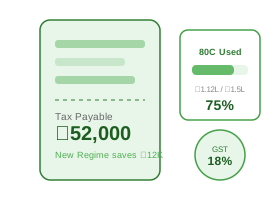
functions Regime Comparison
Old: Std Ded ₹50K + HRA + 80C + 80D + Allowances
New: Only Std Ded ₹75K — no other exemptions
New Regime 87A: Zero tax if taxable ≤ ₹7L
Old Regime 87A: Zero tax if taxable ≤ ₹5L
Real-Life Guide to Using the In-Hand Salary
Take-home from CTC. Use the examples and checks below to turn the number into a practical decision.
When this calculator is useful
Someone comparing a new job offer's CTC against their current take-home pay, or an employee trying to figure out what will actually land in their bank account each month, reaches for this calculator.
For most people, the best way to use the In-Hand Salary is to try the real case first, then change one input at a time. That makes the trade-off visible. For example, with a loan calculator you can change tenure while keeping the same rate; with an investment calculator you can change return assumption while keeping the same monthly contribution; with a health, education or measurement calculator you can check how much one input changes the final category.
The result should answer a practical question: Can I afford this? How much should I save? Is this score enough? Is this measurement within range? What is the safer or cheaper option? If the output does not answer the decision clearly, adjust the inputs until the scenario matches your real situation.
Practical Advice
Use the In-Hand Salary as a planning tool, not just a number generator. Write down the inputs you used, because the final answer is meaningful only when you remember the assumptions behind it.
If the decision affects money, health, tax, safety, academics or legal compliance, keep a second check ready. That second check may be a bank quote, payslip, official rule, prescription, site measurement, mark sheet or invoice.
Common Mistakes
- Assuming in-hand salary is simply CTC divided by 12, ignoring that CTC includes employer PF contribution, gratuity provisioning, and insurance premiums that never touch the employee's bank account.
- Forgetting that the employee's own 12% PF contribution is deducted from the in-hand amount even though it eventually comes back at retirement or withdrawal.
- Not accounting for professional tax, which is a small but fixed monthly deduction (varying by state, often a few hundred rupees) that reduces in-hand pay.
- Ignoring TDS on salary for higher income brackets, which can shrink monthly in-hand pay noticeably compared to a bare CTC-minus-PF estimate.
- Comparing two job offers purely by CTC figure without checking how much of each is fixed pay versus variable bonus, which changes how much is actually guaranteed month to month.
How to Interpret Results
The monthly in-hand figure shown is what should land in your bank account after employer-side costs (PF, gratuity, insurance) and employee-side deductions (PF, professional tax, TDS) are removed from CTC; use it to compare offers on a like-for-like monthly cash basis rather than comparing raw CTC numbers.
A good interpretation looks at both the main result and the supporting values. If a page shows totals, ratios, categories, schedules or warnings, read those together instead of focusing only on the biggest number.
In-Hand Salary FAQs
Useful answers for interpreting the output, avoiding mistakes and using the result responsibly.
Old Regime vs New Regime — Which is Better?
The Old Tax Regime lets you claim HRA exemption, 80C (₹1.5L), 80D, allowance exemptions, and Standard Deduction of ₹50,000. The New Regime (FY 2024-25) offers a higher Standard Deduction of ₹75,000 but no other deductions — simpler but only tax-efficient if you have minimal investments.
Generally: if your HRA + 80C + allowance exemptions exceed ₹75,000, Old Regime saves more tax. The New Regime is beneficial if CTC is below ₹7.75 Lakhs (zero tax after 87A rebate) or if you have minimal deductions to claim.
Frequently Asked Questions
Take-home salary, HRA, and tax regime explained