
savings

Tax Saving 80C Optimizer

Maximize deductions under 80C, 80CCD, 80D, 80E, 80G — compare New vs Old Regime for FY 2024-25
edit_calendar Last updated: Jul 22, 2026 | verified Reviewed by Calkulator Team | timer 2 min read
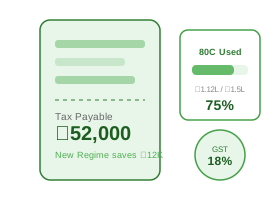
Tax illustration
Tax

Maximise your Section 80C deductions before March 31

EPF, PPF, ELSS, life insurance, home loan principal, SSY, NSC, and tuition fees — all compete for the ₹1.5 lakh 80C limit. This calculator shows your total deductions and the actual tax saved under old regime.

tips_and_updates ELSS has the shortest lock-in (3 years) among 80C options and offers equity market returns.
tuneIncome & Deductions
Gross Annual Income (₹)
Before any deductions
Section 80C (Max ₹1,50,000)
EPF Contribution (₹)
PPF (₹)
ELSS Mutual Funds (₹)
Life Insurance Premium (₹)
NSC / Tax-Saver FD (₹)
Home Loan Principal (₹)
Sukanya Samriddhi / SSY (₹)
Tuition Fees (₹)
Other Deductions
NPS 80CCD(1B) — Max ₹50,000 (₹)
80D — Health Insurance Self (₹)
80D — Health Insurance Parents (₹)
80E — Education Loan Interest (₹)
80G Donation Amount (₹)
Donation Deduction Type
HRA Exemption Already Claimed (₹)

functions 80C Quick Reference

80C: Max ₹1.5L | 80CCD(1B) NPS: +₹50K

80D Self: Max ₹25K | 80D Parents: Max ₹50K

80E: No limit | Std Ded (Old): ₹50K

New Regime: Only NPS 80CCD(2) + ₹75K Std Ded

Total Deductions (Old Regime)
₹—
Enter income and investment details
Tax Saved vs No Deductions
₹—
Old Regime benefit
New Regime Tax
₹—
Effective rate: —
Old Regime Tax
₹—
Effective rate: —
lightbulb
Enter income to see recommendation
We will compare both regimes for you
Gross Income
₹—
Before deductions
80C Used
₹—
Max ₹1,50,000
NPS 80CCD(1B)
₹—
Max ₹50,000
80D Health
₹—
Self + Parents
80E + 80G + HRA
₹—
Other deductions
Old Regime Taxable
₹—
After all deductions
Tax %
—%
Take-home ₹—
Tax (Best Regime) ₹—
insights
Live Result Illustration
Visual summary — updates instantly as you enter values above
LIVE
Salary & Tax Breakdown Updates in real-time Gross Income ₹10,00,000 Income Tax ₹2,00,000 20% PF + Deductions ₹83,000 Net Take-Home ₹7,17,000 71.7% Tip: Max out Section 80C (₹1.5L), HRA, and NPS contributions to legally reduce your tax outgo.
tips_and_updates

Real-Life Guide to Using the 80C Tax Saving

Max 80C deductions and tax saved. Use the examples and checks below to turn the number into a practical decision.

When this calculator is useful

Taxpayers who have opted for or are considering the old tax regime use this near the start of the financial year to plan which instruments to invest in, or in January-March to check how much headroom is left before the ₹1.5 lakh ceiling.

For most people, the best way to use the 80C Tax Saving is to try the real case first, then change one input at a time. That makes the trade-off visible. For example, with a loan calculator you can change tenure while keeping the same rate; with an investment calculator you can change return assumption while keeping the same monthly contribution; with a health, education or measurement calculator you can check how much one input changes the final category.

The result should answer a practical question: Can I afford this? How much should I save? Is this score enough? Is this measurement within range? What is the safer or cheaper option? If the output does not answer the decision clearly, adjust the inputs until the scenario matches your real situation.

lightbulb Real-Life Example
Salaried employee topping up ELSS: A taxpayer in the 20% slab has ₹60,000 already deducted as EPF and has paid ₹40,000 towards a life insurance premium, and wants to know how much more to invest in ELSS mutual funds before 31 March.
1With ₹1,00,000 already used (₹60,000 EPF + ₹40,000 insurance), only ₹50,000 of the ₹1,50,000 limit remains. Investing that ₹50,000 in ELSS reduces taxable income by ₹50,000, saving roughly ₹10,000 in tax at the 20% slab plus applicable cess.
2Now change one input, such as rate, time, quantity, unit or score, and compare the new result with the first one.
Always subtract EPF and existing premiums from ₹1,50,000 first — the remaining gap, not the full limit, is what a fresh investment should target.

Practical Advice

Use the 80C Tax Saving as a planning tool, not just a number generator. Write down the inputs you used, because the final answer is meaningful only when you remember the assumptions behind it.

If the decision affects money, health, tax, safety, academics or legal compliance, keep a second check ready. That second check may be a bank quote, payslip, official rule, prescription, site measurement, mark sheet or invoice.

Common Mistakes

  • Assuming the ₹1.5 lakh limit is per instrument rather than a combined cap across PPF, ELSS, EPF, life insurance premium, and principal repayment on a home loan together
  • Forgetting that employee EPF contribution deducted from salary already eats into the ₹1.5 lakh limit, so a separate ₹1.5 lakh in PPF on top of that does not double the deduction
  • Investing in tax-saving instruments while already having opted for the new regime, where Section 80C is not available at all
  • Overlooking that children's tuition fees qualify only for full-time education of up to two children, not any coaching or private tuition
  • Double-counting home loan principal repayment that is already reflected in the bank's provisional interest certificate under a different head

How to Interpret Results

The output shows how much of the ₹1.5 lakh ceiling you have used, how much room remains, and the approximate tax saved at your slab rate — use the remaining headroom figure to decide how much more to invest before the financial year ends.

A good interpretation looks at both the main result and the supporting values. If a page shows totals, ratios, categories, schedules or warnings, read those together instead of focusing only on the biggest number.

quiz

80C Tax Saving FAQs

Useful answers for interpreting the output, avoiding mistakes and using the result responsibly.

What does this calculator actually calculate?
It totals the amounts you have already invested or paid across 80C-eligible items — PPF, EPF, ELSS, life insurance premium, home loan principal, and tuition fees — compares that total against the ₹1.5 lakh statutory ceiling, and estimates the tax you save at your income slab.
Is the 80C deduction available under the new tax regime?
No. Section 80C, along with most other Chapter VI-A deductions, is not available under the new regime. This calculator is relevant only if you have opted for, or are evaluating, the old regime.
Does the ₹1.5 lakh limit include NPS contributions?
Voluntary NPS contributions under Section 80CCD(1) share the same ₹1.5 lakh umbrella as 80C, but an additional ₹50,000 is available separately under Section 80CCD(1B) exclusively for NPS, over and above the 80C limit. This calculator should let you enter NPS separately to reflect that extra room correctly.
Why does my actual tax saving differ from what the calculator shows?
The calculator estimates savings by applying your slab rate to the eligible deduction, but your final tax also depends on other deductions, rebates, and cess computed together in your full return. Treat the figure as directional for planning rather than the exact rupee amount that will show up in your refund.
Can I claim 80C on a home loan for an under-construction property?
Principal repayment deduction under 80C is available only once the construction is complete and possession has been taken; EMIs paid during construction do not qualify for the 80C principal component until then. Interest paid during construction is treated separately under pre-construction interest rules, not through this calculator.
What happens if I invest more than ₹1.5 lakh in 80C instruments?
Only ₹1.5 lakh of your total 80C investments is deductible in a year; any amount beyond that gets no additional income tax benefit under this section, though the investment itself (like PPF or ELSS) still grows and matures on its own terms. This calculator should cap the deduction at the ceiling even if you enter a higher total.
Does the calculator account for ELSS lock-in or PPF maturity rules?
No, this tool is only about the current year's tax deduction, not investment liquidity. ELSS units are locked in for 3 years and PPF has a 15-year tenure with partial withdrawal rules — factor those separately into your investment choice, not just the tax saved today.
I am self-employed with no employer EPF — does that change how I should use this?
Yes, without employer EPF eating into your limit, you likely have the full ₹1.5 lakh available through PPF, ELSS, insurance premium, or principal repayment. Enter your actual contributions across each category so the calculator reflects your real headroom rather than assuming a salaried employee's typical EPF deduction.

How to Maximize Tax Savings?

The most effective strategy combines Section 80C investments (EPF, PPF, ELSS) to the ₹1.5L cap, additional NPS contribution under 80CCD(1B) for another ₹50K, and 80D health insurance deductions. Together these can save ₹75,000+ in tax for those in the 30% bracket.

Under the New Tax Regime, most deductions are unavailable but you still get ₹75,000 standard deduction and NPS employer contribution benefit. Use this calculator to compare and choose the regime that results in lower tax for your specific situation.

lightbulb Example Calculation
Scenario: Salary ₹12L, EPF ₹72K, PPF ₹50K, NPS ₹50K, 80D ₹25K
180C = ₹1,22,000 (within ₹1.5L limit)
2Total deductions = ₹50K std + ₹1.22L + ₹50K NPS + ₹25K 80D = ₹2.47L
3Old taxable = ₹9.53L | Old Tax ≈ ₹1,06,340
✓ New Regime Tax ≈ ₹1,17,000 → Old Regime saves ₹10,660
live_help

Frequently Asked Questions

80C, NPS, and deduction limits explained

Can I claim 80C deductions under the New Tax Regime?
No. Under the New Tax Regime (default from FY 2023-24), most deductions including 80C, 80D, 80E, HRA, and LTA are not available. The only deductions allowed are the standard deduction (₹75,000), NPS employer contribution (80CCD(2)), and a few others. If your deductions are significant, the Old Regime may save more tax.
What is the NPS deduction under Section 80CCD?
Section 80CCD(1): NPS contribution up to 10% of salary within the ₹1.5L 80C limit. Section 80CCD(1B): Additional ₹50,000 deduction for NPS contributions over and above the ₹1.5L limit, available only in Old Regime. Section 80CCD(2): Employer NPS contribution up to 10% of salary available in both Old and New Regime.
What qualifies as Section 80C investments?
Section 80C allows deductions up to ₹1,50,000 for: EPF, PPF, ELSS mutual funds (3-year lock-in), Life insurance premiums, NSC, Tax-saver FDs (5-year), Home loan principal repayment, Sukanya Samriddhi, and tuition fees. All within-year contributions count toward the ₹1.5L cap.
keyboard_arrow_up