
foundation

Concrete Calculator

Calculate concrete volume, cement bags, sand, and gravel for slabs and columns
edit_calendar Last updated: Jul 22, 2026 | verified Reviewed by Calkulator Team | timer 2 min read
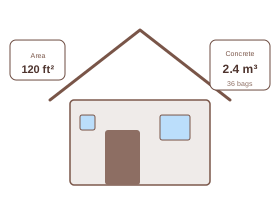
Home illustration
Home

Estimate cement, sand, and gravel needed for your project

Whether you are pouring a slab, filling a column, or building a foundation — enter the dimensions and get the exact quantities of cement bags, sand, and gravel needed. Standard M20 mix ratio is 1:1.5:3.

tips_and_updates Order 10% extra material — spillage, uneven surfaces, and on-site wastage always consume more than calculated.
Shape
Length (m)
m
Width (m)
m
Thickness (cm)
cm
Ready-mix Price (₹/m³, optional)
Mix Ratio Used: 1:2:4
Per 1 m³ of concrete:
• Cement: ~320 kg (~6.4 bags of 50 kg)
• Sand: ~0.44 m³
• Gravel/aggregate: ~0.88 m³
Add 10–15% waste for cuts & spillage
Concrete Volume
Estimated cost:
Cement Bags (50 kg)
Sand Required
Gravel/Aggregate
insights
Live Result Illustration
Visual summary — updates instantly as you enter values above
LIVE
Area & Material Estimate Updates in real-time 12 ft 10 ft 120 sq ft Floor area With 10% Wastage 132 sq ft Buy This Much 132 units Always add 10% wastage for cuts and breakage.
tips_and_updates

Real-Life Guide to Using the Concrete Calculator

Bags of cement for slabs and columns. Use the examples and checks below to turn the number into a practical decision.

When this calculator is useful

Reach for this before pouring a slab, footing, or column so you know how many bags of cement, tonnes of aggregate, and truckloads of sand to order in advance rather than mid-pour.

For most people, the best way to use the Concrete Calculator is to try the real case first, then change one input at a time. That makes the trade-off visible. For example, with a loan calculator you can change tenure while keeping the same rate; with an investment calculator you can change return assumption while keeping the same monthly contribution; with a health, education or measurement calculator you can check how much one input changes the final category.

The result should answer a practical question: Can I afford this? How much should I save? Is this score enough? Is this measurement within range? What is the safer or cheaper option? If the output does not answer the decision clearly, adjust the inputs until the scenario matches your real situation.

lightbulb Real-Life Example
Pouring a 10x10 ft slab: A homeowner in Pune is casting a 10 ft x 10 ft roof slab that is 4 inches (0.33 ft) thick and wants to know how much cement to book from the local supplier.
1Wet volume = 10 x 10 x 0.33 = 33 cu ft. Dry volume = 33 x 1.54 = 50.8 cu ft. For a 1:2:4 mix (7 parts total), cement share = 50.8/7 = 7.26 cu ft, which converts to roughly 5.8 bags of 50 kg cement — the calculator rounds this to 6 bags.
2Now change one input, such as rate, time, quantity, unit or score, and compare the new result with the first one.
Always order the rounded-up bag count, not the exact decimal, because part-bags are not sold and short supply mid-pour ruins the slab's monolithic strength.

Practical Advice

Use the Concrete Calculator as a planning tool, not just a number generator. Write down the inputs you used, because the final answer is meaningful only when you remember the assumptions behind it.

If the decision affects money, health, tax, safety, academics or legal compliance, keep a second check ready. That second check may be a bank quote, payslip, official rule, prescription, site measurement, mark sheet or invoice.

Common Mistakes

  • Entering slab thickness in inches without converting to feet, which can throw the volume off by a factor of 12.
  • Forgetting to add 5-10% extra for spillage, uneven subgrade, and formwork bulging, so the last batch runs short.
  • Using a generic 1:2:4 mix ratio for a footing that actually needs M20 or M25 structural grade concrete.
  • Not accounting for the volume displaced by rebar cage and embedded conduit/pipes in a reinforced slab.
  • Mixing up wet volume and dry volume of concrete — dry volume is roughly 1.54 times the wet volume because of voids between aggregate particles.

How to Interpret Results

The output gives you dry volume converted into bags of cement (typically 50 kg each), cubic feet of sand, and cubic feet of aggregate — round each up to the nearest full bag or the nearest tractor-trolley load your local supplier delivers in.

A good interpretation looks at both the main result and the supporting values. If a page shows totals, ratios, categories, schedules or warnings, read those together instead of focusing only on the biggest number.

quiz

Concrete Calculator FAQs

Useful answers for interpreting the output, avoiding mistakes and using the result responsibly.

What exactly does the Concrete Calculator compute?
It converts the dimensions of your slab, footing, or column into a dry material volume, then splits that volume into bags of cement, cubic feet of sand, and cubic feet of coarse aggregate based on the mix ratio you select, such as 1:2:4 or 1:1.5:3.
Why does the tool multiply my volume by 1.54 before splitting the mix?
Wet concrete settles and compacts, filling the voids between aggregate particles, so the dry, loose volume of cement, sand, and aggregate you need to buy is about 54% more than the finished wet volume of the slab.
My contractor's bag count is different from what the calculator shows — why?
Contractors usually build in their own wastage margin (often 8-10%) and may use a slightly richer mix for beams and columns than for a plain slab, so a modest difference of half a bag to one bag per 100 sq ft is normal and not a sign of error.
Should I use the same mix ratio for a footing and a roof slab?
No — footings and columns typically need a stronger mix such as M20 (roughly 1:1.5:3) because they carry structural load, while a plain PCC bed under flooring can use a leaner 1:4:8 mix; always confirm the grade with a structural engineer for load-bearing work.
How do I account for a slab with a beam or reinforcement running through it?
For a first estimate, ignore the small volume displaced by rebar since it is usually under 2% of the total; for precise budgeting on large slabs, subtract the steel volume separately using the reinforcement quantity given in the structural drawing.
Does this calculator tell me how much water to add?
No, water quantity depends on the water-cement ratio (commonly 0.45-0.5 for structural work) and site conditions like aggregate moisture, so it is best confirmed with your mason or by following the cement manufacturer's guidelines rather than a fixed number.
What if my slab has an irregular shape, like an L-shaped balcony?
Split the area into two or more rectangles, calculate each separately, and add the bag counts together — the calculator works on simple length x width x thickness, so irregular footprints need to be broken down manually first.
What should I do with the result before placing an order?
Round the cement figure up to the nearest whole bag, add your own 5-10% contingency for spillage, and cross-check the sand-to-aggregate ratio against what your local supplier sells by the trolley or truckload so delivery quantities match your calculated needs.

Concrete Mix Ratios Explained

The 1:2:4 mix ratio (cement : sand : coarse aggregate by volume) is the standard M15 grade concrete used for general construction. Higher grades like M20 (1:1.5:3) use more cement for greater strength — for RCC columns and slabs in load-bearing structures.

This calculator outputs dry material quantities. In practice, mix 10–15% extra to account for voids, compaction, and spillage. Ready-mix concrete (RMC) is priced per m³ and delivered pre-mixed — convenient for large pours.

lightbulb Example
Slab: 5m × 4m × 15 cm thick:
1Volume = 5 × 4 × 0.15 = 3 m³
2Cement = 3 × 320 = 960 kg = 20 bags
3Sand = 3 × 0.44 = 1.32 m³
✓ Gravel = 3 × 0.88 = 2.64 m³

quizFrequently Asked Questions

How much does 1 bag of cement cover?
A standard 50 kg bag of cement, mixed in a 1:2:4 ratio, yields approximately 0.035 cubic metres (35 litres) of concrete. For M20 grade mix (1:1.5:3), you need roughly 8 bags per cubic metre. Always add 5–10% for wastage. Exact consumption depends on the mix design and whether batching is done by volume or weight.
What concrete grade should I use for house construction?
M20 (20 N/mm² strength) is the minimum for reinforced concrete slabs, beams, and columns in residential construction. Foundations use M15 for plain concrete (PCC) or M20 for RCC footings. High-rise buildings and exposed structures use M25–M35. Always follow the structural engineer's specifications — never substitute a lower grade to save cost.
How do I prevent concrete from cracking?
Use the correct water-cement ratio (typically 0.4–0.5 for M20) and avoid adding excess water. Cure the concrete by keeping it moist for a minimum of 7 days (28 days for full strength). Avoid placing concrete in extreme heat. Add control joints every 3–4 metres for slabs to guide any cracking to predetermined lines.
keyboard_arrow_up