
science

Molarity Calculator

Calculate concentration (mol/L), moles, mass, or volume for any chemical solution
edit_calendar Last updated: Jul 22, 2026 | verified Reviewed by Calkulator Team | timer 2 min read
Science illustration
Science

Calculate solution concentration for chemistry experiments

Molarity = moles of solute / litres of solution. Dissolving 58.44g of NaCl (1 mole) in 1 litre of water gives a 1M solution. This calculator handles molarity, moles, mass, and volume conversions.

tips_and_updates Always add solute to solvent (not the reverse) when preparing solutions — especially with acids.
Solve For
Mass of Solute (g)
g
Molar Mass (g/mol)
g/mol
Volume of Solution (mL)
mL
Molarity (mol/L)
M
Formulae
C = n / V (mol/L)
n = m / M (mol)
m = n × M (grams)
Results
Molarity (C)
Moles (n)
Mass (m)
Volume (V)
insights
Live Result Illustration
Visual summary — updates instantly as you enter values above
LIVE
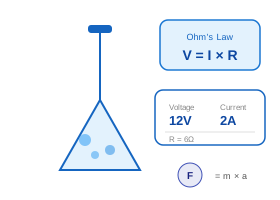
Formula & Result Updates in real-time F = m × a Applied formula Variable A 10 kg × Variable B 12 m/s² = Result 120 N Confirm units before calculating — mixing mm and m is the most common source of errors. Real systems have friction, heat, and tolerance — the formula result is ideal-case. Adjust for real-world conditions.
tips_and_updates

Real-Life Guide to Using the Molarity Calculator

Moles per litre of solution. Use the examples and checks below to turn the number into a practical decision.

When this calculator is useful

Used in a chemistry lab when preparing a solution of a specific concentration from a solid solute, or diluting a concentrated stock solution down to a working strength.

For most people, the best way to use the Molarity Calculator is to try the real case first, then change one input at a time. That makes the trade-off visible. For example, with a loan calculator you can change tenure while keeping the same rate; with an investment calculator you can change return assumption while keeping the same monthly contribution; with a health, education or measurement calculator you can check how much one input changes the final category.

The result should answer a practical question: Can I afford this? How much should I save? Is this score enough? Is this measurement within range? What is the safer or cheaper option? If the output does not answer the decision clearly, adjust the inputs until the scenario matches your real situation.

lightbulb Real-Life Example
Preparing a titration solution: A student needs 500 mL of 0.5 M sodium chloride solution for a titration experiment.
1Moles required = 0.5 mol/L × 0.5 L = 0.25 mol. Mass needed = 0.25 mol × 58.44 g/mol (molar mass of NaCl) = 14.61 g.
2Now change one input, such as rate, time, quantity, unit or score, and compare the new result with the first one.
Weigh out 14.61 g of NaCl, dissolve it in some water, then top up to exactly the 500 mL mark — not add 500 mL of water on top of the solid.

Practical Advice

Use the Molarity Calculator as a planning tool, not just a number generator. Write down the inputs you used, because the final answer is meaningful only when you remember the assumptions behind it.

If the decision affects money, health, tax, safety, academics or legal compliance, keep a second check ready. That second check may be a bank quote, payslip, official rule, prescription, site measurement, mark sheet or invoice.

Common Mistakes

  • Entering volume in millilitres while the molarity formula M = mol/L expects litres, which throws the concentration off by a factor of 1000.
  • Confusing molarity (moles of solute per litre of solution) with molality (moles of solute per kilogram of solvent) — the two are only close for dilute aqueous solutions and diverge for concentrated ones.
  • Assuming the final solution volume equals the volume of solvent added, when in reality dissolving a solid solute changes the total volume slightly — you must top up to the final mark, not just add a fixed amount of water.
  • Using the molar mass of the anhydrous compound when the actual reagent is a hydrate — for example, using 159.61 g/mol for CuSO₄ instead of 249.68 g/mol for CuSO₄·5H₂O.
  • Mixing up the direction of the dilution formula C₁V₁ = C₂V₂, leading to the wrong amount of solvent being added to reach the target concentration.

How to Interpret Results

The result tells you moles of solute per litre of final solution — use it to back-calculate the exact mass of solute (or volume of stock solution) needed, and confirm that quantity is realistically measurable on your balance or pipette.

A good interpretation looks at both the main result and the supporting values. If a page shows totals, ratios, categories, schedules or warnings, read those together instead of focusing only on the biggest number.

quiz

Molarity Calculator FAQs

Useful answers for interpreting the output, avoiding mistakes and using the result responsibly.

What does the molarity calculator find?
It computes molar concentration, M = moles of solute ÷ litres of solution, and can also work backward to find mass of solute or volume needed to hit a target concentration.
What is the difference between molarity and molality?
Molarity is moles per litre of total solution, which changes slightly with temperature as volume expands or contracts; molality is moles per kilogram of solvent, which stays constant regardless of temperature.
Why did my concentration come out 1000 times too high or too low?
This almost always means volume was entered in millilitres instead of litres (or vice versa) — always convert mL to L by dividing by 1000 before using the molarity formula.
How do I dilute a stock solution to a lower concentration?
Use C₁V₁ = C₂V₂, where C₁ and V₁ are the stock's concentration and volume, and C₂ and V₂ are your target concentration and volume — solve for whichever value you need.
Does it matter if my reagent is a hydrate?
Yes — hydrated salts like CuSO₄·5H₂O have a higher molar mass than the anhydrous form because the water molecules are part of the crystal, so using the wrong molar mass gives the wrong mass-to-weigh figure.
What happens near the solubility limit of a solute?
If the calculated mass exceeds what the solvent can actually dissolve at that volume and temperature, the solution becomes saturated and undissolved solid will remain — the calculator assumes full dissolution, so always check solubility tables for very concentrated solutions.
Where is molarity actually used in the lab?
It is fundamental to titrations, buffer preparation, and reaction stoichiometry, where reagents must be delivered in precise mole ratios rather than by mass or volume alone.
What should I do after finding the molarity or required mass?
Use the molecular weight calculator to double-check the molar mass of your specific compound, then weigh the solute accurately and dissolve to the exact final volume using a volumetric flask.

Molarity Explained

Molarity (C) is the most common unit of solution concentration in chemistry — moles of solute per litre of solution (mol/L or M). The relationship between mass, moles, and molar mass is: n = m/M (moles = grams ÷ grams-per-mole). Combining with C = n/V gives you all four variables.

Example: To make 500 mL of 0.1 M NaCl (molar mass = 58.44 g/mol): moles needed = 0.1 × 0.5 = 0.05 mol; mass = 0.05 × 58.44 = 2.922 g. Dissolve 2.922 g NaCl in water and make up to 500 mL.

lightbulb Example
5.85 g NaCl in 500 mL:
1n = 5.85/58.44 = 0.1 mol
2C = 0.1/0.5 = 0.2 mol/L
✓ 0.2 M NaCl solution

quizFrequently Asked Questions

What is molarity and how is it different from molality?
Molarity (M) is moles of solute per litre of solution. Molality (m) is moles of solute per kilogram of solvent. Molarity changes with temperature (solution volume expands with heat); molality does not — it is temperature-independent. For colligative properties like boiling point elevation and freezing point depression, molality is used.
How do I prepare a 1M NaCl solution?
Molar mass of NaCl = 58.44 g/mol. For 1 litre of 1M NaCl: weigh out 58.44 g of NaCl, dissolve in approximately 800 mL of distilled water, then top up to exactly 1000 mL in a volumetric flask. Do not add salt to 1 litre of water — that gives more than 1 litre of solution and a lower-than-intended concentration.
Why is molarity important in chemistry?
Molarity standardises concentration for chemical reactions. Stoichiometry requires knowing the exact number of moles, and molarity converts volume (easy to measure with glassware) to moles. For example, to neutralise 100 mL of 1M HCl with NaOH, you need exactly 100 mL of 1M NaOH — because moles cancel 1:1 in the neutralisation reaction.
keyboard_arrow_up