
savings

Pension Calculator

Estimate your retirement corpus and monthly pension from regular contributions
edit_calendar Last updated: Jul 22, 2026 | verified Reviewed by Calkulator Team | timer 2 min read
Investment illustration
Investment

Calculate your pension corpus and monthly retirement income

Whether you have EPS, NPS, or a private pension plan, knowing your projected monthly pension helps you plan supplementary savings. This calculator shows corpus growth, inflation-adjusted pension, and how long your funds will last.

tips_and_updates Aim for a retirement corpus that generates monthly income equal to 70-80% of your pre-retirement expenses.
Monthly Contribution (₹)
Years to Retirement
yr
Expected Annual Return (%)
%
NPS equity: ~12% · Balanced: ~10% · Debt: ~7%
Expected Inflation (%)
%
Annual Withdrawal Rate (%)
%
4% rule — sustainable for ~30 years
Retirement Projections
Retirement Corpus
Monthly Pension
Inflation-Adjusted Corpus
Real Monthly Pension
Total Invested
Wealth Created
Returns Multiple
insights
Live Result Illustration
Visual summary — updates instantly as you enter values above
LIVE
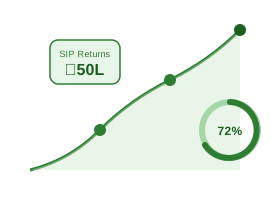
Investment Growth Summary Enter values above to update Invested ₹18 L Amount Total Corpus ₹50.5 L Maturity Total Gains ₹32.5 L Returns on Investment +180% Start early — 5 extra years can nearly double your corpus through the power of compounding.
tips_and_updates

Real-Life Guide to Using the Pension Calculator

Pension payout estimator. Use the examples and checks below to turn the number into a practical decision.

When this calculator is useful

Salaried employees covered under EPF who want to estimate the monthly pension they will receive from the Employees' Pension Scheme (EPS) at retirement, based on their pensionable salary and years of service.

For most people, the best way to use the Pension Calculator is to try the real case first, then change one input at a time. That makes the trade-off visible. For example, with a loan calculator you can change tenure while keeping the same rate; with an investment calculator you can change return assumption while keeping the same monthly contribution; with a health, education or measurement calculator you can check how much one input changes the final category.

The result should answer a practical question: Can I afford this? How much should I save? Is this score enough? Is this measurement within range? What is the safer or cheaper option? If the output does not answer the decision clearly, adjust the inputs until the scenario matches your real situation.

lightbulb Real-Life Example
22 years of EPS service: An employee retiring at 58 has 22 years of pensionable service and an average pensionable salary, capped, of ₹15,000/month.
1Using the EPS formula (Pensionable Salary × Pensionable Service) / 70, with 2 bonus years added for crossing 20 years of service (making it 24), the estimated monthly pension works out to roughly ₹15,000 × 24 / 70, or about ₹5,143 per month.
2Now change one input, such as rate, time, quantity, unit or score, and compare the new result with the first one.
Because the pensionable salary used in the formula is capped, EPS alone typically replaces only a small fraction of pre-retirement income, so it should be treated as a base layer rather than a full retirement plan.

Practical Advice

Use the Pension Calculator as a planning tool, not just a number generator. Write down the inputs you used, because the final answer is meaningful only when you remember the assumptions behind it.

If the decision affects money, health, tax, safety, academics or legal compliance, keep a second check ready. That second check may be a bank quote, payslip, official rule, prescription, site measurement, mark sheet or invoice.

Common Mistakes

  • Using your full basic salary as the "pensionable salary" instead of the EPS wage ceiling that applies to the pension formula, unless you fall under the separate higher-pension option cohort.
  • Forgetting that pensionable service is rounded to the nearest year, with 2 bonus years added if total service exceeds 20 years, so 19.5 years is often treated as 20, not 19.
  • Assuming the estimate automatically reflects job changes — the calculator needs your correct total pensionable service across all employers where EPS was contributed, excluding any non-contributory gap periods.
  • Confusing the EPS monthly pension with the EPF lump-sum withdrawal — these are two separate components of the same retirement account, and this calculator only estimates the monthly pension.
  • Not accounting for early pension from age 50 (reduced by a percentage per year before 58) or deferred pension up to age 60 (with a bonus), both of which change the payout compared to the standard age-58 estimate.

How to Interpret Results

The monthly pension figure is calculated from your average pensionable salary over the last 60 months and total pensionable service — read it as an estimate of your EPS payout alone, separate from any EPF lump sum or personal retirement savings you may also have.

A good interpretation looks at both the main result and the supporting values. If a page shows totals, ratios, categories, schedules or warnings, read those together instead of focusing only on the biggest number.

quiz

Pension Calculator FAQs

Useful answers for interpreting the output, avoiding mistakes and using the result responsibly.

What formula does the pension calculator use to estimate my EPS payout?
It uses the standard EPS formula: (Average Pensionable Salary × Pensionable Service) divided by 70, where pensionable salary is capped and averaged over the last 60 months of service.
Why is my calculated pension so much lower than my actual last-drawn salary?
Because the formula uses a capped pensionable salary figure, not your actual full salary, and divides by 70 — a structural design of EPS meant to provide a base pension, not a full income replacement.
Does this calculator include my EPF lump-sum balance, or only the monthly pension?
It estimates only the EPS monthly pension component. Your EPF lump-sum balance, built from your and your employer's provident fund contributions, is a completely separate amount you would withdraw independently.
What happens to my pension estimate if I switch jobs and there's a gap in EPF contributions?
Only periods where EPS contributions were actually made count as pensionable service, so unaccounted employment gaps should be excluded from the total years you enter to keep the estimate accurate.
Can I take my EPS pension before age 58?
Yes, an early pension option is available from age 50, but the monthly payout is reduced by a fixed percentage for each year before 58 that you start drawing it.
What is the "higher pension" option I've heard about, and does this calculator reflect it?
It refers to a scheme allowing certain eligible employees to have their pension calculated on actual (uncapped) salary instead of the wage ceiling, following specific court rulings — this calculator uses the standard capped-salary formula, so higher-pension-option members should treat the result as a lower-bound estimate.
Is EPS pension income taxable?
Yes, the monthly pension received is taxable as income under the head "salaries" or "income from other sources," depending on how it is classified, and is added to your total income for the year.
What happens to my pension if I pass away — does my spouse receive anything?
Yes, EPS includes a family pension provision, under which the spouse and eligible children continue to receive a pension after the member's death, calculated using a separate set of rules from the member's own pension.

Planning Your Pension

Pension planning works best through consistent monthly contributions compounded over decades. The National Pension System (NPS) offers tax benefits under Section 80C and 80CCD. Employer contributions in EPF are also a key retirement savings vehicle in India.

The 4% rule (safe withdrawal rate) suggests you can withdraw 4% of your corpus annually and sustain it for 30+ years. Inflation adjustment is crucial — ₹1 lakh today will need ~₹3.2 lakh in 20 years at 6% inflation. Always plan using real (inflation-adjusted) returns.

lightbulb Example
₹5,000/month for 25 years at 10%:
1Total invested: ₹15 lakhs
2Corpus: ~₹1.97 crores
✓ Monthly pension ~₹65,600 (at 4% rule)

quizFrequently Asked Questions

What is the National Pension System (NPS) in India?
NPS is a government-sponsored defined contribution pension scheme open to all Indian citizens (18–70 years). Contributions go into equity (Scheme E), government bonds (Scheme G), or corporate bonds (Scheme C). At 60, you must use at least 40% of the corpus to buy an annuity; the remaining 60% can be withdrawn tax-free. Tier-1 contributions get tax benefits up to ₹2 lakh under 80C + 80CCD(1B).
How much pension will I need after retirement?
A commonly cited rule is to replace 70–80% of your pre-retirement income. Apply inflation: at 6% over 25 years, ₹1 lakh/month today becomes ~₹4.3 lakhs/month at retirement. At a 4% safe withdrawal rate, that requires a corpus of approximately ₹4.3L × 12 ÷ 0.04 = ₹12.9 crore. Use this calculator to work backwards from your target monthly pension.
When should I start saving for retirement?
The earlier, the better. Starting at 25 instead of 35 with the same monthly investment grows your corpus to roughly 3× more by age 60 at a 12% return — the extra decade of compounding is that powerful. A simple starting rule: save at least 15% of your gross income towards retirement from your very first salary.
keyboard_arrow_up